The Imam’s Anti-Historical Revolutionary Program
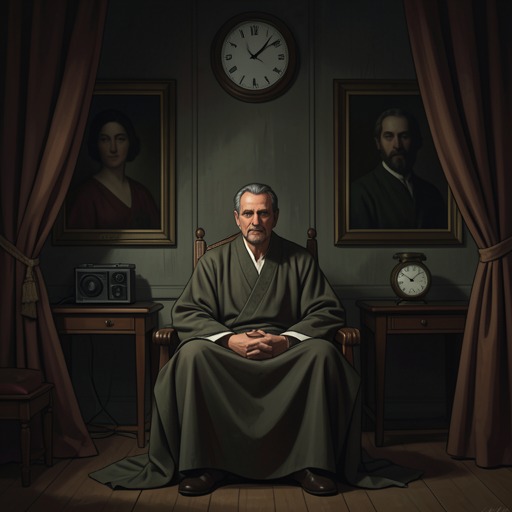
The Satanic VersesThe Imam’s Anti-Historical Revolutionary Program turns political revolt into a campaign against time itself. In Gibreel Farishta’s recurring dream narrative, the Imam presents history, progress, science, and human rights as deviations from a completed divine revelation; his promised alternative is an eternal order beyond change. The program’s imagery of water overcoming wine and clocks being destroyed gives this rejection a vivid form, even as the dream’s unstable accounts of who speaks for God complicate its claims to certainty.
Doctrine and Political Purpose
The Imam’s public message travels through an unexpected channel: Bilal X sings over surreptitious radio waves from Kensington, and his voice emerges in dreamed Desh as the Imam’s thunderous speech. The broadcast begins by listing the Empress Ayesha’s alleged crimes and proceeds to summon the people against her rule. The Imam makes the political aim larger than replacing a tyrant: the revolution must also overthrow history. In his account, history belongs to Shaitan and carries the false promises of progress, science, and rights. Because revelation was complete when Allah’s message came to Mahound, further knowledge appears not as discovery but as delusion and deviation.
Bilal X’s voice is itself part of the program’s argument about power. The Imam chose him for its beauty and authority, qualities cultivated in a successful popular-singing career. Bilal objects when the Imam associates that voice with the powerful, since Bilal too belongs to an oppressed people. The Imam’s answer is that proximity to power teaches its habits, even to those it oppresses. The voice becomes a weapon turned against the political order it once seemed to serve: its reach and authority help carry the revolutionary message, while the Imam interprets its tone as evidence of an acquired political inheritance.
Time, Water, and the Revolution
The doctrine gives its political conflict a contrast between stillness and movement. The Imam associates himself with water, fertility, and eternity, while he casts Ayesha as decay and as a prisoner of passing time. His promised revolution will abolish clocks and birthdays, and even expunge the word clock from the language. Its adherents are to be reborn at one unchanging age in God’s sight. This is not merely a change of government: the program imagines a world in which human lives no longer register succession, aging, or historical difference.
The dreamed uprising gives that promise a public, collective form. People advance towards the palace in a slow procession, despite the guards’ weapons and the deaths along the route. Gibreel Farishta contests the Imam’s interpretation of their devotion, understanding their movement as a response to Ayesha’s oppression rather than proof of love for the Imam. The Imam, however, reads their advance as confirmation that people long for divine eternity. When the crowd reaches the guns, the weapons are silenced and the people continue towards the palace. The Imam declares the revolution accomplished; the palace goes dark as the marchers enter.
The vision then turns the political victory into a supernatural image. Al-Lat bursts out of Ayesha’s shell, falls, and disappears, leaving a dark stain. The clocks of Desh begin chiming without end, beyond ordinary measures of hours and days. The scene therefore does not simply deliver the clockless eternity the Imam promised: the clocks continue to sound, but their counting exceeds any usable scale. The ending names the beginning of the Imam’s Untime, a new order announced through the very instruments meant to measure historical time.
Revelation and the Problem of Authority
The revolutionary doctrine’s appeal to completed revelation sits within a wider narrative that questions how sacred speech is received and authenticated. In an earlier episode, Mahound tells Salman the Persian that listening to Gibreel feels like a kind of asking, and that the angel can seem to come from within his own deepest self. Mahound describes people who witnessed miracles—including the washing of his heart in the waters of Zamzam Spring and his Night Journey to Jerusalem—yet continued to worship Lat, Uzza, and Manat. His question is not only why they disbelieve, but what more he can recite to persuade them.
At the poetry gathering, Mahound begins reciting verses that affirm the goddesses’ intercession. Later, after wrestling with the figure he identifies as the Archangel Gibreel, he concludes that the earlier verses came from Shaitan and returns to remove them from the record. Yet the narration preserves a destabilizing detail: Gibreel knows that the same voice spoke both the verses and their repudiation. The episode makes revelation’s authority difficult to separate from the speaker, the listener, and the interpretation subsequently imposed on what was heard.
Salman the Persian’s later experiment intensifies that uncertainty. After a dream restores his memory of the earlier episode, he secretly alters the words he records for Mahound, first making small substitutions and then changing a reference from Christians to Jews. Mahound accepts the altered wording without noticing, and Salman leaves Yathrib when he fears that a further change will expose him. The episode does not establish that the Imam’s doctrine is simply Salman’s conclusion; rather, it supplies another narrative case in which the boundary between revelation and human mediation becomes contested. The book’s acknowledgements also state that its Qur’an quotations are composites of existing English versions with some additions of the author’s own, marking the text’s literary construction without resolving the fictional characters’ disputes.
Dream Narrative and Political Contradictions
The program reaches readers as part of Gibreel Farishta’s repeated, involuntary dream narratives, not as a detached political tract. In the sequence concerning the Imam and Ayesha, Gibreel sees the revolution’s violence and hears the Imam explain it as a passage from historical time to eternity. His disagreement with the Imam matters because it prevents the revolutionary leader’s interpretation from becoming the only account of why the people rise. The same procession can be claimed as evidence of love for the Imam and read as a consequence of tyranny.
The doctrine also contains a tension between its promised liberation and its demand for submission to a single completed truth. It attacks the Empress’s power in the name of timeless divine authority, but assigns the Imam the voice that defines history, knowledge, and the proper path. Its rejection of change is expressed through a revolution that must overturn the existing state; its promise to end time arrives in a scene where clocks continue chiming. These contradictions make the program more than a simple opposition between religion and secular modernity. The dream joins political rule, religious interpretation, and control over knowledge, while leaving the claimed escape from history entangled with the upheaval required to bring it about.